
Peach County Criminal Records
Criminal court records in Peach County are the clerk-held files for cases that have entered the court system. The record may begin with a warrant, accusation, indictment, or other charging paper, then grow as arraignments, bond orders, motions, hearings, plea forms, verdicts, disposition entries, and sentencing orders are filed. The Peach County Clerk of Superior Court is the main custodian for Superior Court criminal case files, including felony matters. State Court, Magistrate Court, Probate Court traffic, and Fort Valley or Byron Municipal Court may hold separate lower-court criminal or citation records.
Georgia does not use a county "district court" label for Peach County trial records. The Peach County Superior Court is part of the Macon Judicial Circuit with Bibb and Crawford counties, and Superior Court handles felony prosecutions. Magistrate Court may handle warrants, first appearances, and preliminary criminal functions before a case moves forward. Arrest and booking data sit with the sheriff and jail, while the filed charge list and outcome sit in the court file. A person checking custody should use the Peach County inmate record route, but a person checking the case result should read the criminal docket.
Search Peach County Criminal Records
The county research points to the Peach Clerk public portal as the official starting point for Superior Court records, with a separate Tyler-hosted Peach County web access portal and Magistrate Court disclaimer route for available Magistrate matters. Portal access may show index-level entries before document images, and the research did not inspect a live Peach County sample criminal case. Use the case number when known. It cuts down false matches.
- Identify the court first. Felonies are Superior Court matters, while misdemeanors may be State Court or another court depending on the charge path.
- Use the Clerk of Superior Court portal for Superior Court criminal records, or the Tyler access route for Magistrate records where the matter is preliminary or warrant-related.
- Search by defendant name, business name if relevant, or exact case number. Add date or case-type filters if the portal offers them.
- Open the case result and read the docket entries, charge rows, hearings, pleas, disposition, and sentencing entries as separate facts.
- Request certified copies from the clerk that holds the file. An online index is useful, but it is not a certified court copy.
State-level systems can help when the question is broader than one Peach County case. Georgia Felon Search is an official name-based felony conviction search, and the Georgia Department of Corrections offender query is for sentenced state-prison custody. Those sources do not replace a Peach County criminal court record because a court file can show dismissed counts, pending hearings, plea details, local bond orders, and case-specific sentencing terms.
The manifest image from Georgia Felon Search shows the state conviction-check route that may supplement a Peach County criminal case search.
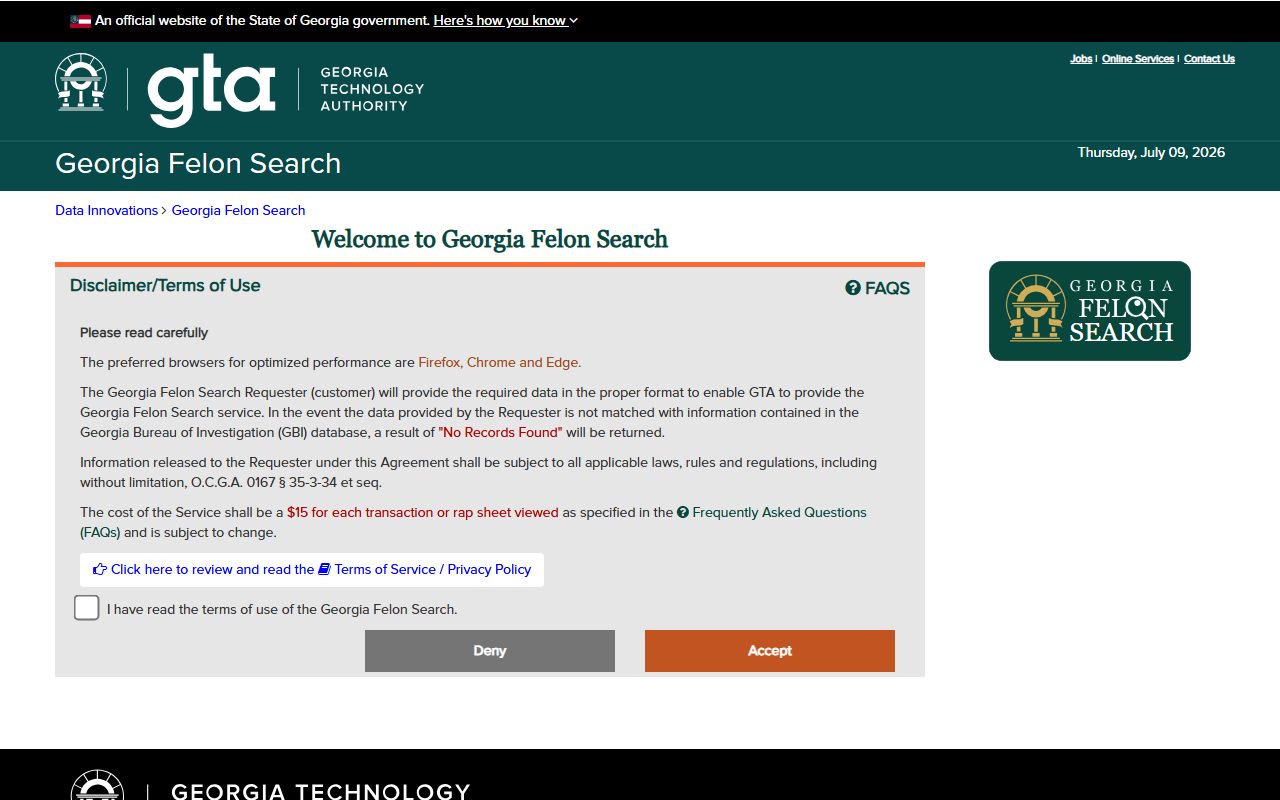
Use that state portal for conviction-history context, then return to the Peach County court file when the needed fact is a charge, motion, hearing, disposition, sentence, or certified copy from the local case.
Peach County Criminal Case Flow
A criminal case record changes as the case moves from arrest or warrant activity into filed court action. The docket is the running list of filed events. In Peach County, felony cases are tied to Superior Court and the Macon Judicial Circuit, while Magistrate Court may appear early because magistrates handle warrants, first appearances, and preliminary criminal matters. A charge can be pending at first, then amended, reduced, dismissed, or resolved by plea or trial. Do not read the first charge entry as the final outcome.
Case flow: Charges Filed › Arraignment › Pretrial and Motions › Plea or Trial › Disposition › Sentencing
| Stage | What the Criminal Record Shows |
|---|---|
| Charges filed | The accusation, indictment, warrant-based charge, or other filing that identifies the alleged offense and court. |
| Arraignment | The defendant is advised of the charge, counsel status may be addressed, and a plea may be entered. |
| Pretrial and motions | The docket may show discovery filings, bond orders, continuances, suppression motions, or other requests to the judge. |
| Plea or trial | The record may show a negotiated plea, trial verdict, acquittal, mistrial, or dismissal. |
| Disposition and sentence | The case outcome and sentence terms may show jail, prison, probation, fines, restitution, costs, or special conditions. |
Note: A Peach County court record can update after a state or jail database changes, so compare source dates before relying on either result.
Peach County Criminal Record Fields
Research did not locate a freely viewable Peach County sample criminal case with verified portal fields. The court-record inventory still identifies the common Georgia case data points that may appear by venue and access level. Treat each field as a case-file clue, not as a background-check verdict. Older files, sealed matters, juvenile cases, and restricted criminal history may be missing from public results even when the courthouse file exists.
| Field | What It Shows |
|---|---|
| Case number | The court-assigned identifier used by the clerk, prosecutor, and parties. |
| Court name | Superior, State, Magistrate, Probate, Juvenile, Municipal, or another issuing court. |
| Case style | The caption, often State v. Defendant in a criminal case. |
| Charges | Alleged offenses, severity, count structure, and later changes if the docket reflects them. |
| Docket entries | Chronological filings, hearings, notices, orders, continuances, pleas, and disposition entries. |
| Financial terms | Bond, fines, costs, restitution, probation fees, or other amounts when entered in the case. |
| Sentence | Court-imposed jail, prison, probation, community service, treatment, or other conditions after conviction. |
Criminal Charges vs Convictions
A Peach County criminal court record can show both accusations and outcomes. That distinction matters. A charge means the government alleged an offense and filed it in a criminal process. A conviction means the charge ended in a guilty plea, guilty verdict, or other conviction entry. A docket can also show a dismissed count, a nolle prosequi entry, an acquittal, or a reduced charge. The full charge history may be relevant for court research, but it should not be described as proof that every listed count became a conviction.
| Point | Charge | Conviction |
|---|---|---|
| Meaning | An allegation filed by law enforcement or the prosecutor through the court process. | A final guilt finding or guilty plea entered on the record. |
| Timing | Appears early and may change as the prosecutor reviews the case. | Appears after plea, verdict, or other final action on that count. |
| Use | Helps explain why the case exists and what was alleged. | Shows the court outcome that may drive sentencing and criminal-history reporting. |
Peach County Criminal Access Laws
Georgia's public-records framework supports access to public records unless a law makes the record confidential or exempt. Court files are still requested from the court clerk that holds the case, not from one countywide records desk. For Peach County criminal records, that means Superior Court felony files route through the Clerk of Superior Court, preliminary Magistrate materials route through Magistrate Court where available, and city cases may route to Fort Valley or Byron Municipal Court. The county open-records request process is better suited to sheriff records and county administrative records than certified court copies.
Key Georgia access rules:
O.C.G.A. 50-18-70 states the general open-records rule, subject to exemptions.
O.C.G.A. 50-18-71 covers response timing and lawful search, retrieval, and copy costs.
O.C.G.A. 35-3-37 governs eligible Georgia criminal record restriction.
Public access is not the same as full access. Redacted identifiers, sealed filings, attorney work product, active investigative material, confidential exhibits, and restricted criminal history can be withheld from public view. Certified copies require direct clerk contact even when the online index is public.
Peach County Restricted Criminal Records
Georgia commonly uses the term record restriction for many criminal-history limits. A restricted record may be blocked from ordinary public criminal-history dissemination while still available to courts, law enforcement, prosecutors, licensing users, or other authorized entities. Juvenile court records have separate confidentiality rules, and adoption or protected family records are not ordinary public criminal files. A Peach County dismissal or acquittal may support restriction in some cases, but eligibility depends on the exact disposition and Georgia law.
| Point | Restricted or Sealed | Expunged or Deleted |
|---|---|---|
| Georgia framing | Public access can be limited for eligible criminal history or sealed court material. | Do not assume Georgia deletes every court record after restriction. |
| Who may still see it | Courts, law enforcement, prosecutors, and other authorized users may retain access. | Access depends on the statute and order, not on public portal wording. |
| Best proof | A court order, agency confirmation, or official criminal-history response. | A missing portal result is not proof of deletion. |
The Georgia Public Defender Council is the statewide source for public defense structure, and the Macon Judicial Circuit public defender route may matter when counsel was appointed in a Peach County criminal case.

Public defender appointment can appear on a docket, but the defense file and attorney-client communications are not public criminal court records.
Read Peach County Dispositions
Disposition is the court outcome for a charge or case. Common entries can include guilty, not guilty, dismissed, nolle prosequi, reduced, transferred, or otherwise disposed. Sentence is different from disposition. A sentence tells what the judge ordered after a conviction, such as confinement, probation, fines, restitution, conditions, or credit for time served. Probation and parole are also different. Probation is a court sentence served in the community under supervision; parole is supervised release after prison under executive authority.
When a Peach County criminal record lists more than one count, read each count on its own. One count may be dismissed while another ends in a plea. A bond entry does not prove guilt. A warrant entry does not prove conviction. A final judgment, plea, verdict, or sentencing order is stronger evidence of outcome than an early docket note. For the charge path before final disposition, use the Peach County arrest and court charge records page.
Note: No official Peach County page published a complete certified-copy fee schedule in the research file, so verify copy costs with the clerk before ordering.